

Gabriel Olympie recently had to explain why hiring a Full Stack ML Engineer for a Data Analytics role isn’t a good idea and ended up writing a short document outlining the main types of ML-related roles (not exhaustive, of course), which we think is worth sharing outside of our community.
It brought quite a bit of clarity. When he explained these kinds of roles and stacks, being explicit about both responsibility (tech vs. business) and focus (analytics vs. product) proved particularly helpful.
One reflection he shared was about the notion of a tech horizon. When looking in a technical direction, you’re constrained by how deeply and narrowly you understand the underlying layers of the tools you use.
He pointed out that it’s important to stay aware of what you don’t know in these areas so you can investigate when needed. At the same time, being too much of a purist about definitions and methods can introduce inefficiencies, so it’s really about finding the right balance.
Tech-Business vs Product–Analytics Matrix
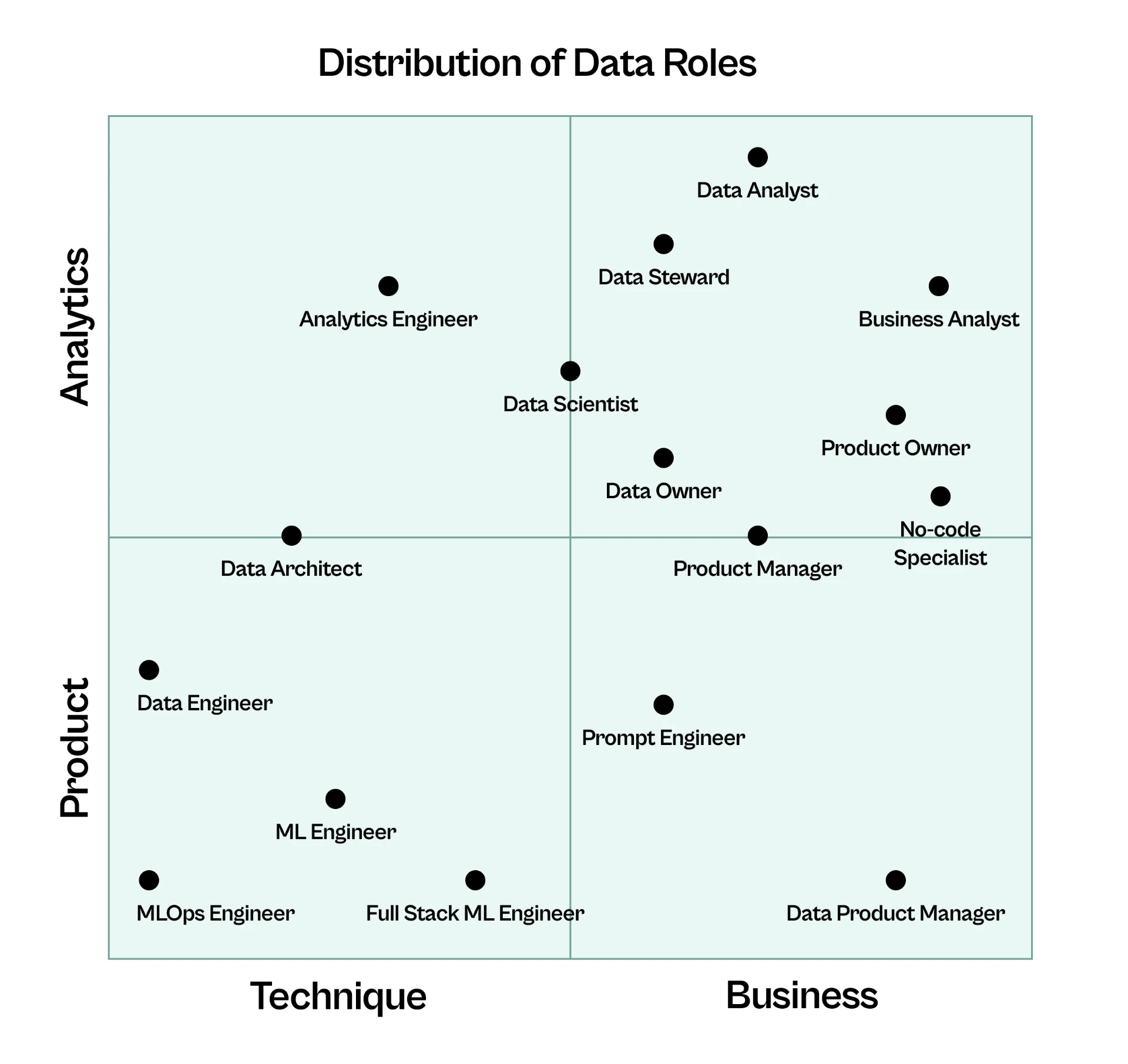
Technical: focuses on the “how” — its main goal is to find the right tools and architecture to solve a given problem.
Business: focuses on the “what/why” — its goal is to understand how value is created and what drives it.
Product: focuses on solving a specific pain point or user need, often starting from a user story to define the scope and build the right solution.
Analytics: seeks to extract insights from data, taking a hypothesis-driven approach to confirm or invalidate intuitions about how to improve the business.
Analytics Engineer
Definition: Transforms raw data into clean, tested, and documented data models ready for analysis by business teams.
Related Roles: Data Analyst, Data Engineer, BI Developer.
Typical Tech Stack: Advanced SQL, dbt (Data Build Tool), Python, Git, LookML.
Business Analyst
Definition: Translates business needs into functional requirements for technical teams and ensures that developed solutions address company challenges.
Related Roles: Data Analyst, Data Product Manager, Product Owner.
Typical Tech Stack: BI tools (as a user), Excel, Jira, Confluence; SQL knowledge is a plus.
Data Analyst
Definition: Explores data, creates dashboards, and communicates insights to help business teams make informed day-to-day decisions.
Related Roles: Business Analyst, Analytics Engineer, Product Owner.
Typical Tech Stack: SQL, BI tools (Tableau, Power BI, Looker), Python (Pandas, Matplotlib), R, Excel/Google Sheets.
Data Architect
Definition: Designs the company’s overall data architecture to ensure consistency, security, and scalability of the ecosystem.
Related Roles: Data Engineer, MLOps Engineer, Head of Data.
Typical Tech Stack: Deep knowledge of SQL/NoSQL databases, data warehouses, data lakes, and cloud architectures.
Data Engineer
Definition: Builds and maintains the infrastructure and pipelines that collect, store, and make data reliably and efficiently available.
Related Roles: MLOps Engineer, Data Architect, Analytics Engineer.
Typical Tech Stack: Python (Airflow, Dagster), Scala (Spark), SQL, Docker, Kubernetes, Kafka, cloud platforms (AWS, GCP, Azure), data warehouses (Snowflake, BigQuery).
Data Owner
Definition: Responsible for a specific business data domain (e.g., customer data, product data). Ensures data quality, security, and compliance from a business and legal perspective.
Related Roles: Data Steward, Head of Data, Business Analyst.
Typical Tech Stack: No specific technical stack; uses governance and documentation tools (Collibra, Alation, Jira, Confluence).
Data Product Manager
Definition: Defines the vision, strategy, and roadmap for data-based products (e.g., a recommendation engine, scoring API).
Related Roles: Business Analyst, Product Owner, Head of Data.
Typical Tech Stack: Jira, Asana, Confluence; solid understanding of SQL and the data ecosystem required.
Data Scientist
Definition: Uses statistics and machine learning to build predictive models and uncover hidden opportunities in data.
Related Roles: Data Analyst, Research Scientist.
Typical Tech Stack: Python (Scikit-learn, TensorFlow, PyTorch, Pandas, NumPy), R, SQL, Jupyter Notebooks.
Data Steward
Definition: Operationally manages the quality, documentation, and metadata of a data domain, applying the policies defined by the Data Owner.
Related Roles: Data Owner, Analytics Engineer, Data Engineer.
Typical Tech Stack: Data cataloging and governance tools (Collibra, Atlan, DataHub), SQL (for investigation), data quality tools.
Full Stack ML Engineer
Definition: Develops end-to-end applications (front-end and back-end) that consume or expose data or ML models to end users.
Related Roles: ML Engineer, Data Product Manager, Front-End Developer.
Typical Tech Stack: JavaScript (React, Vue), Python (FastAPI, Django), REST/GraphQL APIs, model interaction via APIs (SageMaker, Vertex AI, etc.).
Head of Data
Definition: Defines the company’s data strategy, manages teams and budgets, and ensures that data initiatives align with business objectives.
Related Roles: Data Architect, Data Product Manager, C-level (CTO, CDO).
Typical Tech Stack: Management and reporting tools; conceptual understanding of all technical stacks within the team.
ML Engineer
Definition: Takes machine learning models and deploys them into production, focusing on scalability, performance, and integration within applications. Related Roles: MLOps Engineer, Data Engineer, Data Scientist, Full Stack ML Engineer. Typical Tech Stack: Python (FastAPI, Flask), Docker, Kubernetes, MLOps cloud platforms (SageMaker, Vertex AI), CI/CD tools.
MLOps Engineer
Definition: Implements platforms and processes to automate the ML lifecycle (training, deployment, monitoring). Related Roles: ML Engineer, Data Engineer, DevOps Engineer. Typical Tech Stack: MLflow, Kubeflow, DVC, Terraform, Ansible, Docker, Kubernetes, Jenkins, GitLab CI.
Product Manager
Definition: Defines the vision and roadmap of a software product or feature, focusing on user needs and business goals. Uses data for decision-making but does not build “data products.” Related Roles: Data Analyst, Data Product Manager, Full Stack ML Engineer. Typical Tech Stack: Jira, Asana, Confluence, product analytics tools (Amplitude, Mixpanel).
Product Owner
Definition: Manages the data team backlog, prioritizes tasks (analyses, features), and acts as a bridge between stakeholders and the development team.
Related Roles: Business Analyst, Data Analyst, Data Product Manager.
Typical Tech Stack: Jira, Trello, Confluence, Asana.
Prompt Engineer
Definition: Designs, tests, and optimizes prompts (instructions) for language and generative AI models to achieve desired outcomes and improve performance in specific use cases. Related Roles: Data Scientist, ML Engineer, AI Product Manager, Content Strategist. Typical Tech Stack: LLM platforms (OpenAI, Hugging Face), Python (LangChain, LlamaIndex), Jupyter notebooks, versioning tools (Git).
No-Code Automation Specialist
Definition: Builds and manages automated workflows and integrations between business applications using no-code or low-code platforms, reducing the need for traditional development.
Related Roles: Business Analyst, Product Owner, Data Analyst (for simple collection/transformation).
Typical Tech Stack: Zapier, Make (ex-Integromat), Airtable, Bubble, Microsoft Power Automate, Salesforce Flow.