

Audio
🎙️ SpaceXAI shipped Grok Voice Transcribe 2.0 – Aimed at the audio where speech-to-text usually breaks: flaky phone lines, accents, spoken email addresses and language switches mid-sentence. Trained on live, noisy, multilingual recordings, it cut errors on short voice commands by two thirds versus v1.0.
Autonomous Agents
🐝 Hivemind gives MCP agents shared memory – Memory files usually leave context stranded inside each agent, IDE or vendor, with a human stitching it together. This open-source layer moved memory to the shared workspace, so any agent could see what others were doing and inherit what they learned.
Biotech, Health, and Chemistry
🧬 Recursion’s TxFM licensed to Tempus – Transcriptomics models often fail to beat simple linear baselines despite enormous training sets. TxFM made the case that curation beats scale, outperforming models fed up to 100x more data. The non-exclusive deal covered clinical oncology use, $12M over two years. It set the state of the art on zero-shot perturbation representation across three held-out cell lines, against 16 public models.
-
Ablations pointed to an extreme 90% masking ratio, a Poisson-based loss and a new rectified tanh activation suited to count data.
-
Its learned gene parameters recovered known pathways and protein complexes without direct supervision.
🔬 Claude flagged CRISPR-like ART enzyme system – Combing public DNA databases, Claude agents appear to have been first to notice an odd setup in giant phages: a known enzyme that copies RNA into DNA, sitting next to a mystery protein and an array of evenly spaced repeats. The hunt took about 950 agents and 21 hours.
-
The run gathered over 200,000 reverse transcriptases, surfaced 3,500 candidate systems and narrowed them to 20 with human-readable reports.
-
The result came out of Anthropic’s new Bay Area life sciences lab, where human scientists run all BSL-1 and BSL-2 experiments.
-
First experiments showed the repeat array is expressed as distinct short RNAs, and CRISPR pioneer Feng Zhang said it merits further investigation.
-
Community take: Maziyar Panahi of OpenMed argued the “discovery” had not happened yet since “they still don’t know what it does”, while Ihab Bendidi of Recursion noted that “bioinfo pipelines at the same compute scale could be better, could be worse, we don’t know though, so it’s a shame they didn’t have this baseline.”

🦠 Serratus, the cheaper petabase-scale precedent – Long before Claude’s ART run, this open-science project searched 10.2 petabases of public sequencing data for under $24k, uncovering 130,000+ new RNA viruses and a trove of reverse transcriptases with an optimized BLAST query. Ron Alfa’s four-word verdict on the week: “inference is the assay”.
- Community take: Félix Raimundo of Tychobio called Serratus “genuinely my favorite paper” and read Alfa’s post as a jab at AI-pilled claims: “They could synthesize and test it in a week for like $10k.” Ihab Bendidi of Recursion added: “Some really cool things can be done if you really want to do proper science without the fluff.”
🧩 BindCraft2 unified protein binder design – Pick a target protein and the kind of binder wanted, from short peptides to antibody fragments, and this open-source suite designs candidates end to end: AlphaFold 2 drafts sequences, ProteinMPNN refines them and structural checks rank which ones deserve a lab test.
📚 RA Capital and Pillar biotech resources – A starter kit put together by Félix Raimundo of Tychobio for anyone launching a biotech or deep tech company, covering the strategy, the finance and the practical side of building a lab-based startup.
-
The Entrepreneur’s Guide to a Biotech Startup: Peter Kolchinsky’s book, dubbed the biotech bible.
-
RA University: RA Capital’s free courses on how the biotech industry works, from drug economics to valuation models.
-
Pillar VC biotech playlist: a Boston seed fund’s founder hub with IP guides, lab-space tips and pitch deck templates.
Image, Video & 3D
📱 Supra2-IMG, a 100M-parameter image generator – Small enough to run on a phone and fine-tune on personal photos, this text-to-image model was trained from scratch on synthetic images in about nine hours on a single GPU, and billed as state of the art for its size.
- Community take: Louis Choquel of Pipelex saw a light generator to bundle with Pipelex for fully local runs, “like a million times simpler” than a full ComfyUI dependency, but side-by-side tests cooled the hype: Pierre Chapuis of Finegrain found “’quality similar to SD 1.5’ is a bit optimistic” and Gabriel Olympie of 2501.ai found it “way weaker than advertised” on most prompts.
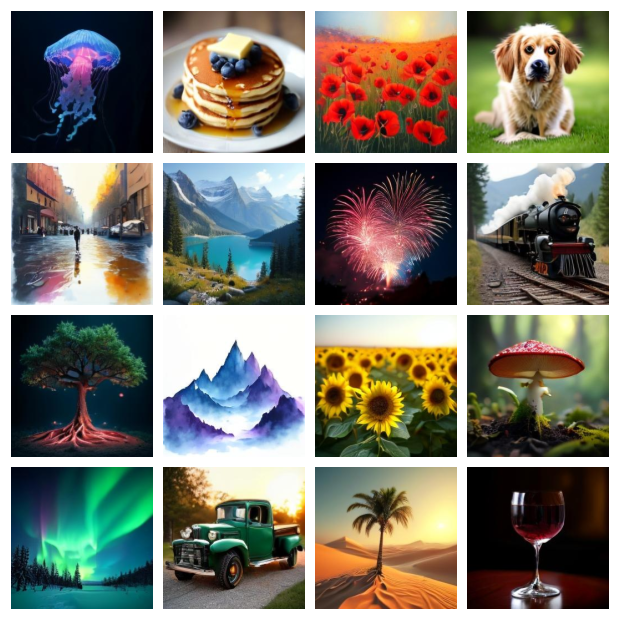
🖼️ Qwen-Image-2.1 added native transparency – A single open-source model now handled both generating and editing images, with transparency built in: it could lift a subject out of a photo as a clean cutout, blend up to 10 reference images into one scene, or rework only a circled region.
🌀 PixelDiT2 grounded pixel diffusion in representations – Diffusion models that draw straight in pixels skip the autoencoder but learn slowly, having to work out image structure alone. This paper fed them that structure from a frozen vision encoder at every step, beating its predecessor’s quality with 4x less training.
Language Models
🧠 Anthropic released Claude Opus 5.5 – The first Claude 5.5 model delivered Claude Fable 5.1-level results on most work while costing 40% less to run than Opus 5, answered over 30% faster and scored best yet on Anthropic’s automated behavioral audit.
-
One tester finished a 680,000-line code migration in under a day, work that would have taken an engineering team weeks.
-
It was much less likely than recent models to take hard-to-reverse actions or step outside its instructions, and resisted prompt injection better.
-
It led on agentic coding, computer use and knowledge work benchmarks, with Sonnet 5.5 and Haiku 5.5 due in the coming weeks.
-
Community take: Gabriel Olympie of 2501.ai found it “very good, efficient, and with strong instruction following, day and night compared with Opus 5”, and as Opus 5.5 + Blender demos spread, Julien Millet noted that “Blender functions internally with code, so it’s pretty easy to drive.”
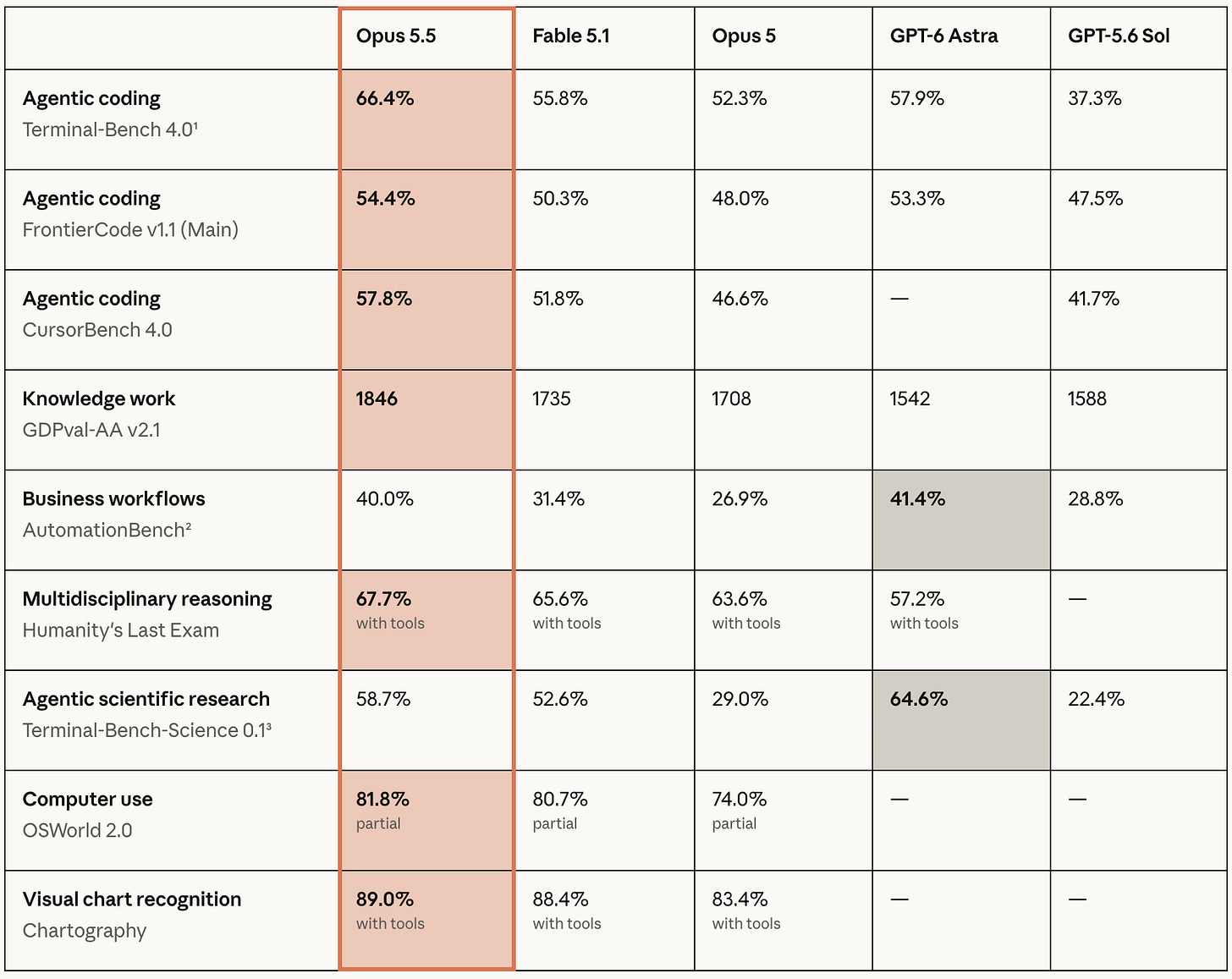
🌗 OpenAI listed GPT-6 Sol and Luna – OpenAI’s GPT-6 lineup quietly filled out in its API docs: Sol, a workhorse for coding and agents, and Luna, a lightweight model for high-volume jobs priced at a hundredth of flagship Astra. All three share the same million-token context.
🌐 Xiaomi open-sourced MiMo-V2.6 omnimodal models – Built in public: the reinforcement learning run behind the Pro and Flash models was streamed live, then the code, training environments and report were released. Pro landed as the strongest open model on the Artificial Analysis index, ahead of Kimi K3 and Qwen3.8 Max.
-
The whole RL phase took under six days and roughly $2.6M for Pro, and alone lifted it 14 points on the held-out DeepSWE coding benchmark.
-
An UltraSpeed variant of Pro delivered the same quality up to 20x faster.
-
Beyond code, demos showed it building games, Blender 3D models and interactive worlds from plain prompts, and steering a robotic arm in simulation.
⚡ SpaceXAI released Grok 4.7 – Trained longer on harder, multi-hour tasks, the new coding model learned to stay on long jobs and double-check its own work. A rebuilt safety stack topped jailbreak and biosafety tests while rarely blocking legitimate security work.
Contributors This Week
Gabriel Olympie, Félix Raimundo, Pierre Chapuis, Youssef Tharwat, Ihab Bendidi, Robert Hommes, Louis Choquel, Tejas Chopra, Amine Saboni, Clement Poiret, Maziyar Panahi, Quentin Dubois, Christophe Lesur, Emmanuel Benazera, Gabriel Duciel, Jean du Terrail, Julien Millet, Julien Seveno-Piltant, Jérémie Bordier, Kemal Toprak Uçar, Lior Oren, Nancy Wang