

Community
🏭 Shipfox manifesto for Continuous Engineering – Noé Charmet of Shipfox argued that once agents write the code, a team’s process becomes the asset: triage, review, and release steps turn into versioned, tested software. Its eight principles included built-in stopping conditions and evidence from every run.
🔀 Weflayr launched benchmark-driven model routing – Noe Achache’s team made Weflayr generally available: an AI gateway that benchmarks candidate models on a customer’s own past calls, then routes each new request to the model that scored best on similar ones.
Events
🇧🇪 FOSDEM 2027 in Brussels (January 30-31) – Europe’s biggest open source conference will be free to attend, with Belgian beer evenings after hours.
Biotech, Health, and Chemistry
🧬 AlphaGenome 2 predicted cell-specific variant effects – Google DeepMind released AlphaGenome 2, which predicts how a DNA variant changes gene activity in one specific cell type at a time. Trained on 107M+ single-cell profiles across 68 tissues, it flagged nearly twice as many causal variants as its predecessor.
Image, Video & 3D
🗣️ Nuance Labs launched Emma video persona – Nuance Labs launched Emma, a face-to-face AI persona built on Nuplex, its full-duplex audiovisual model, plus a beta API. The team found that chasing higher benchmark scores made conversations feel worse, so it built Emma around natural conversation instead.
⚡ MiniMax H3-Image generated 4K in seconds – MiniMax released H3-Image, an open-weight model that it claimed generates and edits 16-megapixel images in about 10 seconds, with up to 16 reference images per request. Weights went to Hugging Face, with hosted access via the MiniMax API and Hailuo AI.
🎨 ByteDance Seedream 5.5 added multi-turn editing – ByteDance Seed shipped Seedream 5.5, an image model that applies successive edits while keeping untouched regions identical at the pixel level. It also generated native transparent backgrounds and extracted subjects as separate layers, ready to reuse.
Cyber
🛡️ OpenAI GPT-6 Cyber automated exploit discovery – OpenAI introduced GPT-6 Cyber, a model that finds exploitable vulnerabilities and writes fixes while staying within the scope a researcher authorizes. It scored 48.5% on ExploitGym, up from 32.1% for GPT-5.6 Cyber, and stayed in scope in 99.93% of tests.
-
OpenAI reported 81 new high-severity Firefox flaws disclosed to Mozilla, and working exploits for 948 of 1,724 reproduced Linux kernel vulnerabilities, more than five times GPT-5.6 Sol.
-
It was rated Critical in cybersecurity under OpenAI’s Preparedness Framework, up from High, and shipped with action-level misalignment monitoring and automated misuse review.
-
Access was initially limited to approved Daybreak Red customers through the API and Codex, with a $1B grant program subsidizing under-resourced defenders.
Language Models
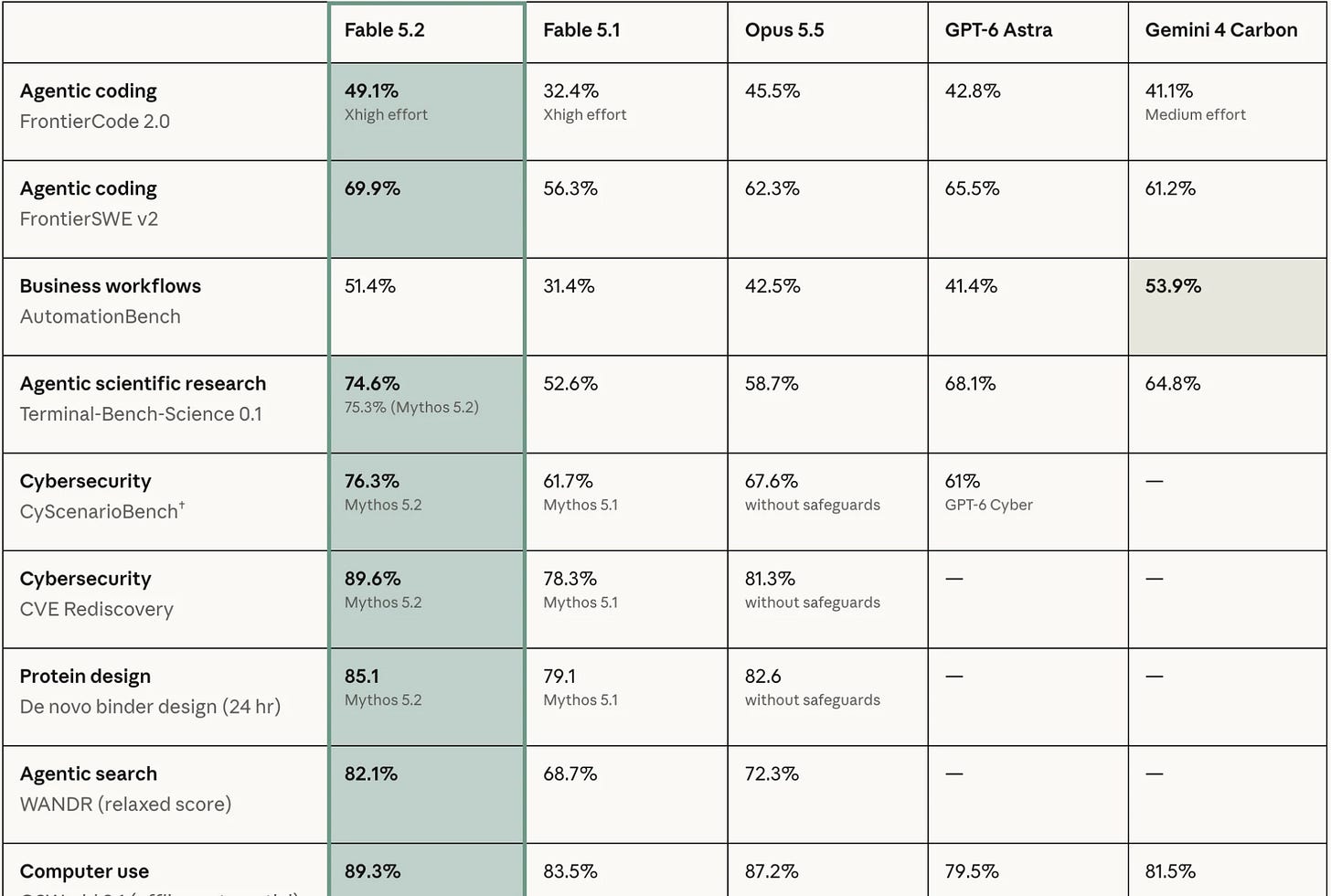
🧮 1,000 Fable 5.2 agents formalized Fermat – A team of 1,000 agents running an early Claude Fable 5.2 reproduced a formal proof of Fermat’s Last Theorem in 28.7 hours, coordinating only through Git and a shared Postgres database. The September version took 11 days with researcher steering. Thread by Lance Martin.
-
The run used one-third of the output tokens and produced a proof one-seventh the length of the earlier formalization.
-
The lead agent created five coordination tables in 10 minutes, and the hardest lemma, Langlands–Tunnell, grew into a 2,418-task tree worked by about 750 helpers.
-
Every shell command and file edit passed a classifier before running, and red-team tests found that monitors reading chain-of-thought caught all sabotage attempts.
🧪 Qwen4-Max preview opened for testing – Alibaba opened a Qwen4-Max preview, the first Qwen 4 model, with a one-million-token context, aimed at coding, agents, and front-end work. It runs until November 25, with no weights or pricing, and Qwen4-27B, Flash, and Plus still undated.
- Community take w/ Gabriel Olympie of 2501.ai: “Early evals apparently, but I don’t know how much trust to put in them, since the 27B seems to score better than the Max version.”
💻 Edge0-145B brought 145B parameters on-device – Edge0 open-sourced Edge0-145B for local coding, reasoning, and agent tasks, claiming 29GB peak memory and 80+ tokens/s since only about 10B parameters activate per step. Etienne Balit of Hypermind found in its NOTICE file that it was a Qwen3.8-Flash-Next derivative.
🔋 NVIDIA Nemotron Bolt targeted local assistants – NVIDIA released Nemotron 3.5 Bolt E4B, a small open model for voice assistants, characters, and robots that holds conversations and calls tools in about 4GB. Post-trained from Gemma 4 E4B, it often beat the original on NVIDIA’s benchmarks.
Programming
📊 Harness Leaderboard ranked ten coding agents – A Hugging Face leaderboard ran ten coding-agent harnesses, including Claude Code, Codex, OpenCode, and OpenClaw, on identical model weights across Terminal-Bench 2.1 and DeepSWE. Rankings shifted with model and effort level, and OpenClaw consistently came last.
- Community take w/ Kevin Kuipers of TTY: “It seems they compared the API token rate of Claude Code with others, not the subscription cost. That makes a huge difference.”
Robotic, World AI
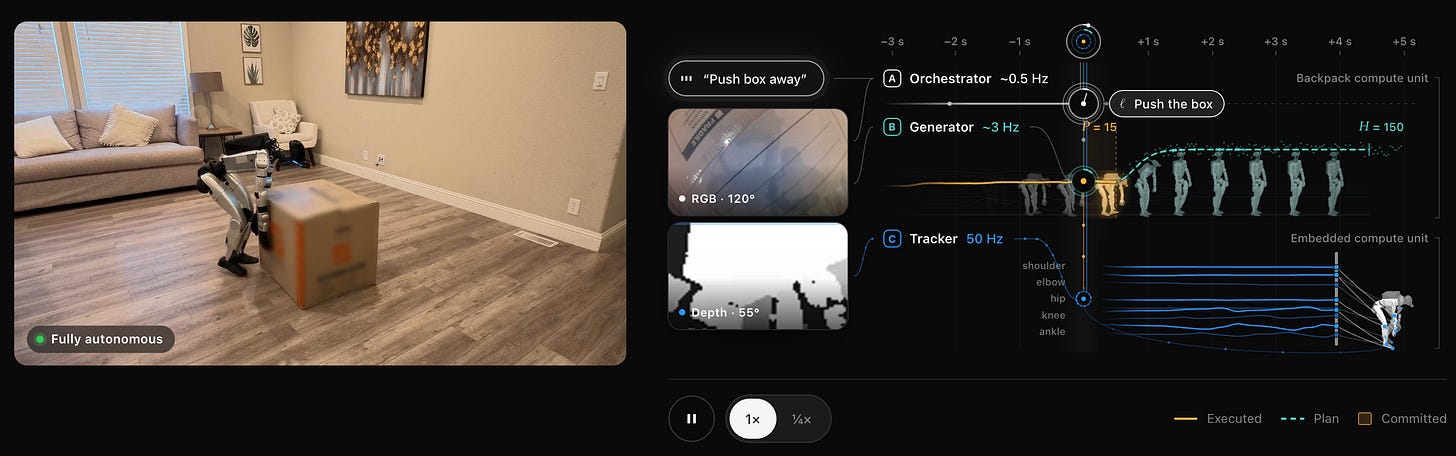
🤖 Apple HALO trained humanoids in simulation – Apple trained HALO, a humanoid autonomy stack, entirely on synthetic data from 1,000 procedurally generated homes, then ran it on a Unitree G1 to sit, navigate, and crawl on spoken request. It reached 91% success in six real homes it had never seen.
-
A VLM split requests into subtasks, a motion generator built on a frozen Qwen3.5-2B encoder planned 5-second whole-body moves, and a 50 Hz tracker drove 29 joints.
-
The 300-hour training corpus was synthesized in 48 hours on 250 H100 GPUs, so data scaled with compute instead of human labor.
-
Planning ran on a Mac mini M4 Pro while a Jetson Orin NX handled motor control, and more environment diversity lifted success from 43% to 81%.
🚗 NVIDIA Alpamayo 2 Edge reasoned onboard – NVIDIA detailed Alpamayo 2 Edge, a 2B-parameter driving model that turns surround-camera video into trajectories and explains its decisions only when a scene calls for it, skipping reasoning in routine traffic. It ran at 160 to 190ms latency on DRIVE AGX Thor.
🌍 IFM open-sourced PAN 2 world model – The Institute of Foundation Models released PAN 2 under Apache 2.0, with weights, training, and inference code. It simulates what happens after each action, pairing a multimodal LLM that plans who does what and when with a 29B diffusion model that renders it.
🌐 Zeromatter came out of stealth – Zeromatter, founded by former leads of Tesla’s Autopilot simulation, came out of stealth with simulated worlds for training and testing autonomous machines. It built its own physics engine after finding none could simulate robotic manipulation accurately enough.
This week’s TTY Lunch
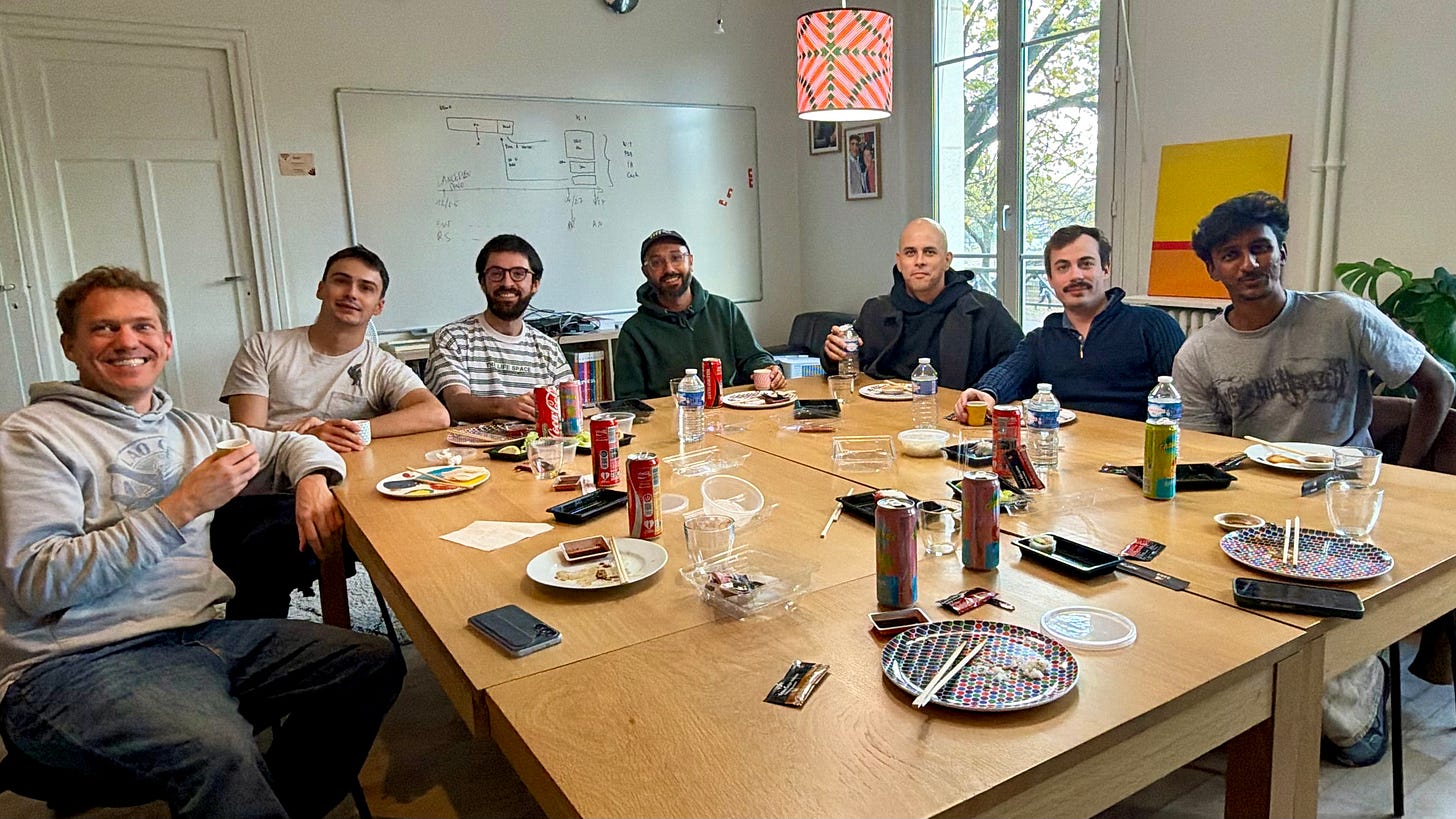
Each week, TTY Lunch brings together exceptional builders around the table at 2050’s HQ.
Today’s lineup included Côme Demarigny, Chris Thomas (UMA), Hugo Venturini (Mistral), Khaled Maâmra (Edgee), Olivier Desclaux (Harmattan AI), Stéphane Béreux (Jimini AI), Thomas Payet (Meilisearch), and my partner in crime, Willy Braun.
Main topics this week:
🤖 Robotics is moving faster, but scaling is still hard (supply constraints, manufacturing know-how, and safety regulation).
🪖 How military spending accelerates robotics development, and what might carry over to civilian uses.
🎛️ What makes Nvidia’s moat so durable and what it would take for Europe to build credible alternatives.
📈 How startups can compete as the big AI labs expand into their markets.
😔 How public concerns about AI and the environmental footprint of data centers could shape the industry.
🎓 What AI means for jobs and education as even graduates from top engineering schools face a tougher job market.
As always, thank you all for joining and contributing to the insightful conversation!
Contributors This Week
Gabriel Olympie, Pierre Chapuis, Jérémie Bordier, Cédric Deltheil, Félix Raimundo, Nancy Wang, Noe Achache, Noé Charmet, Quentin Dubois, Robert Hommes, Amine Saboni, Constant Razel, Etienne Balit, Mario Cornejo, Côme Demarigny, Chris Thomas, Hugo Venturini, Khaled Maâmra, Olivier Desclaux, Stéphane Béreux, Thomas Payet, Willy Braun