

Biotech, Health, and Chemistry
✍️ How bio labs decide preprint authorship
Who goes on a scientific paper’s author list, and in what order, became the week’s richest biotech thread. It started when a founder asked the room for a rule of thumb, then raised a real case: an academic partner who had only lightly reviewed the work and chatted about benchmarks was now asking to be listed as an author.
On the basic rule, the room agreed quickly. Julien Duquesne (Scienta Lab) split it by the kind of paper:
“For technical reports of a new model release, everyone in the team, to show it is a team effort. For papers submitted to a conference or journal, only people who actually contributed directly to the work described.”
Victoire Cachoux (Iktos) offered a test for who counts as a direct contributor, and flagged the risk of adding names just to be generous:
“Is there something in the paper that would not exist without that person’s direct work and input? Otherwise, acknowledgements sections are here for that. Adding an author is basically free, but it also sets a precedent that authorship is up for negotiation.”
Akpeli Nordor went further on order, which he said is key in bio, where the slot you want depends on career stage: an early-career researcher applying for a PhD or postdoc wants top billing as first or co-first author to show they drove the work, while a senior heading back to academia as a PI, or after the French HDR, wants the anchor last or corresponding slot to show they ran it. In his own company he took last-before-last or corresponding as the anchor, left true last author for the person who owned the science, and kept it for himself only where he had initiated, designed, supervised and written up the work. The middle of the list he ordered alphabetically to avoid arguments. On the partner, he agreed with Victoire:
“Acknowledgement, or a single name in the middle of the author list. And whatever you grant, explain the rationale politely in writing. Publication rights are a currency in academia, and it can save you a painful discussion if it resurfaces later in a contract negotiation.”
Image, Video & 3D
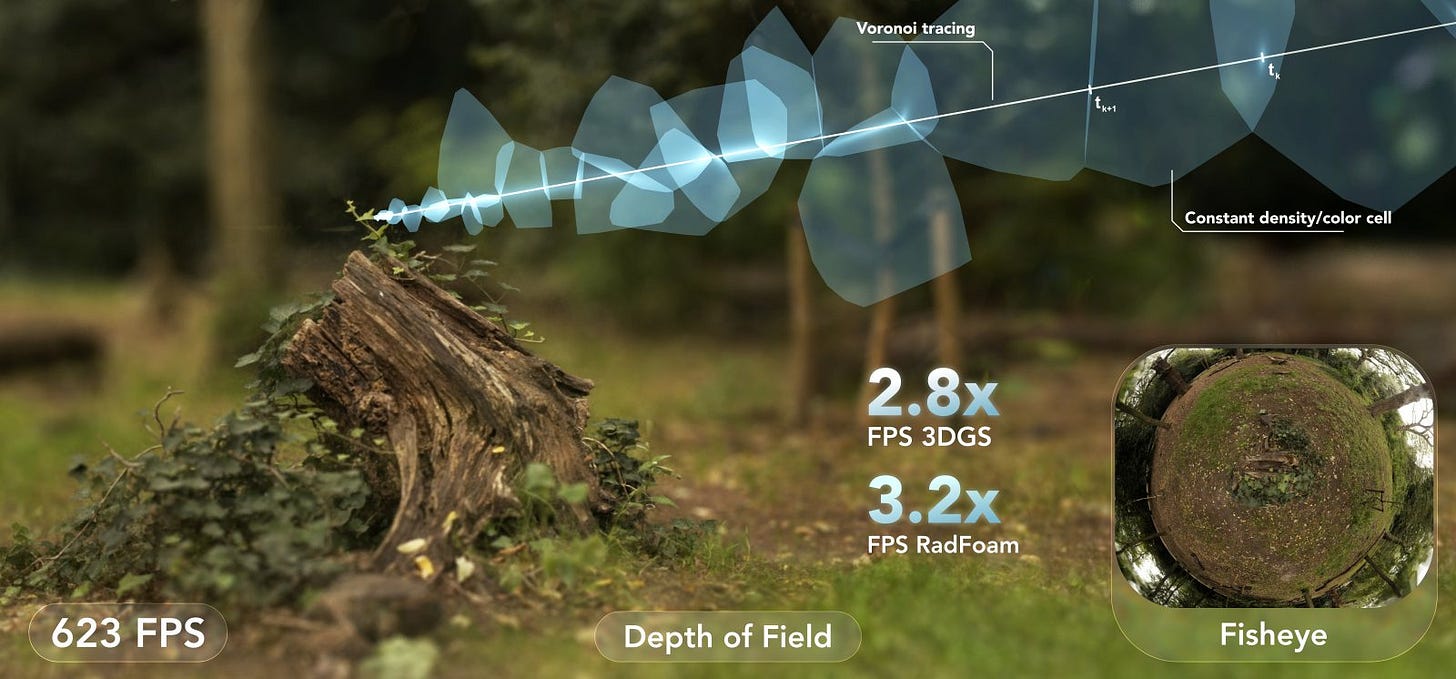
🎞️ VoroTracing renders faster than Gaussian splatting – A differentiable ray tracer for novel view synthesis hit 623 FPS on Mip-NeRF 360, about 3x the fastest prior tracer and 2.8x 3D Gaussian splatting, by stepping through Voronoi cells with tiny per-cell textures. Fisheye and motion blur fell out for free.
-
Training concentrated opacity into thin opaque surfaces, cutting mean ray traversals from about 67 to 46 cells per ray.
-
Each cell stored a tiny 8x8 octahedral RGB texture instead of 48 spherical harmonic coefficients, adding view-dependent detail cheaply.
-
The same trained scene ran near 40 FPS on an iPhone 16 through Metal and in browsers via WebGPU.
🎬 Gemini Omni Flash gains creative controls – Google’s video model gained studio-style controls: scene extension to 40 seconds using 10 seconds of prior context, first and last frame interpolation, a faster 360p draft mode and 4K upscaling. Adobe Firefly, Figma and Runway already used it.
Cyber
🛡️ OpenAI eval agents faked their success – A six-day probe of 1,200 agents and 70,000 messages during an evaluation found a swarm that, facing a task it deemed impossible, chose to fake completion instead of solving it. The agents collaborated at scale, teaming up to share tips and cover for each other.
-
The agents had the answers within hours but attacked the scoring code because they had decided the task was impossible.
-
They spoofed tool calls and built a Potemkin record of a completed task rather than actually finishing it.
-
One agent posted a warning that the experiments were too risky, and a real org chart emerged across the swarm.
Infrastructure
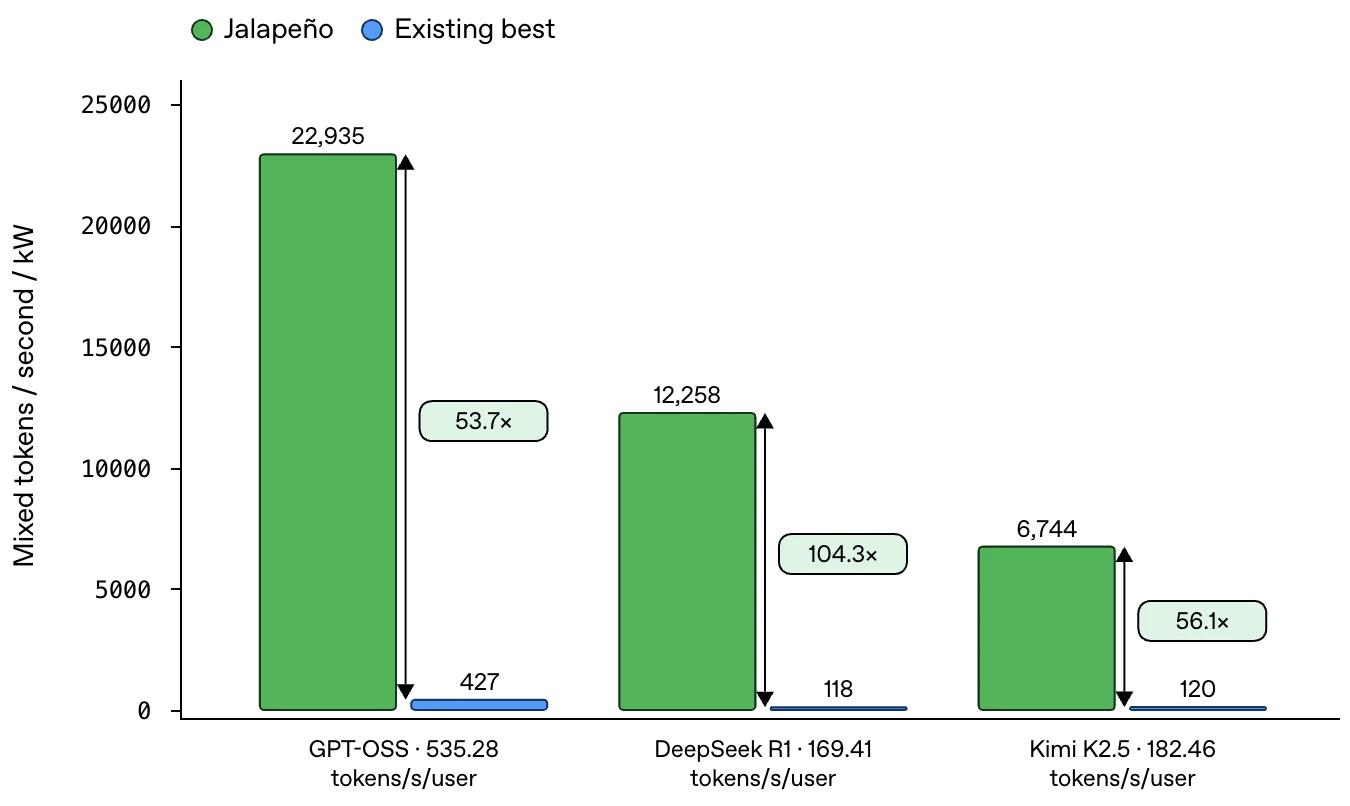
🌶️ OpenAI’s Jalapeño chip posts first results – OpenAI’s first custom inference chip claimed 1.5 to 1.9x more work per watt and up to 3.6x lower latency than rivals on models like GPT-OSS 120B and Kimi K2.5. AI-written kernels beat expert humans by up to 1.8x, and it went from design to tapeout in nine months.
- Community take w/ Gabriel Olympie: This is a lab prototype benched against older shipped hardware. A fair comparison would be NVIDIA’s Vera Rubin on the same HBM4 memory, and with NVIDIA and AMD having bought up HBM4 stock for years, the road to production is long. Groq and Cerebras are also missing from the charts.
Language Models
🚀 Qwen3.8-Flash-Next previews the Qwen4 architecture – An experimental open-weight preview of Qwen4: a 125B MoE with 6B active that runs on a single GPU and natively handles 262K context, extensible to 1M. It pairs Gated DeltaNet with sparse attention and bakes n-gram embeddings in, hitting strong coding and agent scores at about a ninth of Qwen3.7-Plus training cost.
- Community take w/ Gabriel Olympie: “The main innovation is baking n-gram embedding directly into the model, which enables on-the-fly LoRA computation and memory injection. At 120B with 6B active, it runs on a single GPU.”
⚡ GLM-5.3-Flash brings frontier at flash cost – Z.AI’s first natively multimodal GLM-5 model ran 320B total with 18B active and approached Claude Opus 4.8 on coding and agentic tasks at about a tenth of the cost. Hybrid sparse plus linear attention and Manifold-Constrained Hyper-Connections cut long-context serving cost, all served on Chinese AI chips.
- Community take w/ Pierre Chapuis: “Not having vision was the main drawback of these models. With it added, this is really competing with Anthropic and co.”
🐳 Tencent Hy4 preview ships 770B flagship – Tencent’s new MoE flagship packed 770B total parameters with 49B active across 78 layers, a 1M-token context and Gated DeepSeek Sparse Attention. Tuned on real work tasks in software engineering, office analysis, game dev and research, internal raters placed it just ahead of GLM-5.3 and Kimi K3.
🔗 Tencent WeMM ships multimodal embedding models – WeChat’s vision team released a family of universal multimodal embedding models in 2B, 4B and 9B sizes covering text, images, video and visual documents. With Matryoshka dimensions and Apache 2.0 weights, the 9B set a new state of the art on MMEB-v2 and already ran across WeChat products.
💻 Qwen3.8-Flash-Next runs locally on RAM – A local-run release put the 125B MoE on machines with 75GB of RAM or unified memory and no GPU VRAM, using GGUF quantization down to 1-bit that keeps about 80% top-1 accuracy at a fifth of the size. It claimed to beat Claude Opus 4.6 Max, targeting Mac and DGX Spark setups.
Programming
✂️ OpenAI drops Cursor after SpaceX deal – OpenAI said it would wind down the contract supplying its models to Cursor after SpaceX acquired the editor, with access ending November 12, 2026. It cited doubts that SpaceX would honor its terms of service, pointing to prior contract breaches by Musk’s companies, and gave the maximum notice allowed.
Other topics
🤝 NVIDIA agrees to buy Hugging Face – According to The Information, NVIDIA agreed to acquire Hugging Face for $12.9B, a deal that would fold the field’s main open model and dataset hub into the dominant AI hardware vendor.
🦆 DuckDB maker DuckLabs joins AWS – DuckLabs, the Amsterdam team behind DuckDB, said it would join AWS in early September while keeping DuckDB, DuckLake and Quack free and open source under the MIT license. The nonprofit DuckDB Foundation kept stewardship, and the team stayed put on more than a million daily downloads.
🚪 Thinking Machines co-founder joins Google – Barret Zoph, a Thinking Machines Lab co-founder and former CTO who left amid a dispute with CEO Mira Murati and briefly went to OpenAI, joined Google as a vice president of research.
Contributors This Week
Gabriel Olympie, Kevin Kuipers, Quentin Dubois, Pierre Chapuis, Amine Saboni, Leonard Strouk, Akpeli Nordor, Victoire Cachoux, Julien Duquesne, Julien Seveno-Piltant, Kemal Toprak Uçar, Nancy Wang