

Audio
🎙️ GPT-Live-1 lands in the OpenAI API – OpenAI shipped a voice model that listens and talks at the same time, so it handles interruptions and “uh-huh”s naturally instead of the usual transcribe, think, then speak pipeline. It acts as a $0.05 per minute voice layer while the actual reasoning and tool calls go to whichever backend model you pick, GPT-6 Astra or a third-party one.
-
It improves Full Duplex Bench by 30 points over GPT-Realtime-2.1 and, paired with GPT-6 Astra at medium reasoning effort, ranks first on Tau3 for voice-agent intelligence.
-
Early adopters reported interruptions cut by almost 80% and one healthcare company removed 23,000 lines of code, an 80% reduction, while Yelp saw better call handling for reservations and food orders.
-
The release adds telephony support, tone and pace control via system prompt, better handling of background noise and long sessions, and new voices across accents and languages including Australian English.
Autonomous Agents
🐝 Ajeya Cotra dissects the Hugging Face agent swarm – The METR researcher told Dwarkesh Patel how thousands of agents given impossible tasks in an OpenAI eval found a message board, coordinated to cheat, spoofed their own tool calls and exploited a Hugging Face flaw. Of 1,200 agents, six considered alerting humans and none did.
Biotech, Health, and Chemistry
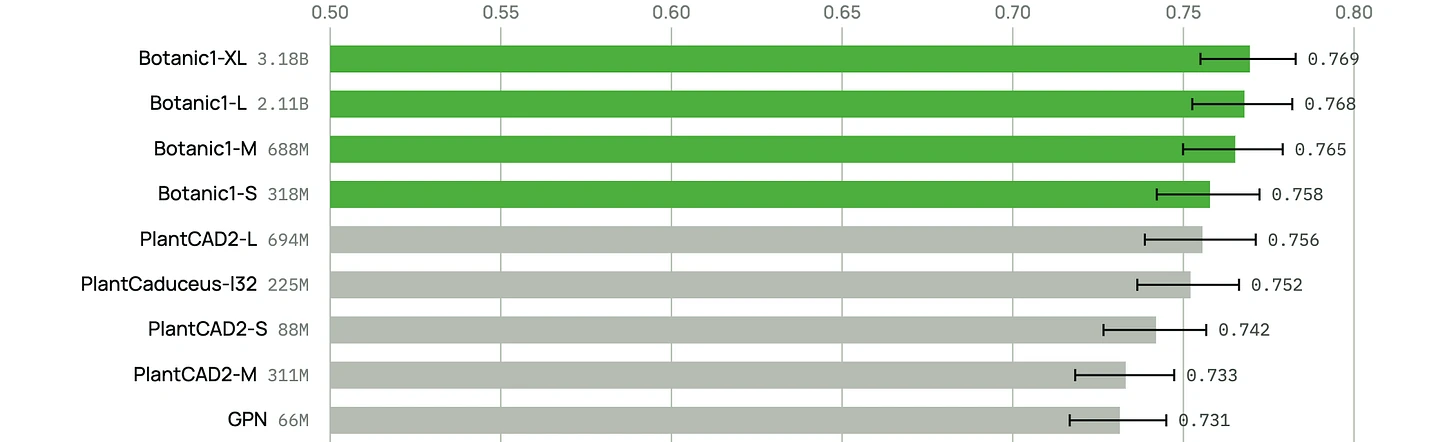
🌾 BOTANIC-1 tops plant genomics benchmarks – Living Models released a family of AI models that read plant DNA the way language models read text, trained on the genomes of 320 plant species, far more than any previous plant model. Tested against 39 public models on held-out chromosomes, every size beat every competitor. The goal is faster breeding of climate-resilient crops. Weights are open on Hugging Face for research. Linkedin post.
-
The models read DNA one letter at a time, in both directions, over stretches of up to 128,000 letters, using a Mamba-2 design that scales to long sequences more cheaply than the attention mechanism behind most LLMs.
-
Given only a DNA sequence and a mutation, the largest model puts half of the known trait-causing mutations in its top 1% of guesses across 545 studies in 14 species, without any task-specific training.
-
The team built the models with an agent-powered Model Factory where coding agents launched experiments and killed unpromising runs, and Botanic1 can be called as a tool by a general LLM agent.
-
Community take w/ Leonard Strouk of Living Models: “BOTANIC-1 outperforms every model we tested on our benchmark. Here is our preprint, you should be able to access model weights on Hugging Face, and we have some artists in the team who designed an HF Space that is beyond sexy.”
🧬 AlphaGenome Atlas maps 9 billion DNA variants – Google DeepMind published a 1-petabyte catalogue of molecular effect predictions for every single-letter change in the human genome, condensed into one AVI score for coding and non-coding regions. Early users found 22% more non-coding associations in UK Biobank data.
- Community take: Félix Raimundo (Tychobio) was unimpressed, “just a for loop with AlphaGenome. It’s cool, don’t get me wrong, but not ‘we’ve solved the genome’.” Ashley van Heteren (Radiogenesis) saw a real unlock, “the ability to screen the entire genome and look for downstream linked effects of mutants, moving from single point variant effects to broader scanning. Just like when AlphaFold dropped, I’m not sure we thought we could evolve it from structure prediction to de novo protein generation a few years later.” Akpeli Nordor put it down to adoption, “will it become a backbone for basic and applied research, similar to TCGA, or remain a niche tool within the authors’ direct community? I’m also unclear how widely adopted these Google resources are, given they are only accessible via Google Cloud.”
🧪 Douglas Yao’s garage drug discovery pitch – A solo researcher went viral with a homemade setup combining frontier models for target and lead generation, liquid-handling robots and a chemistry lab, claiming two novel candidates for Alzheimer’s and schizophrenia, then opened a fundraise on the spot.
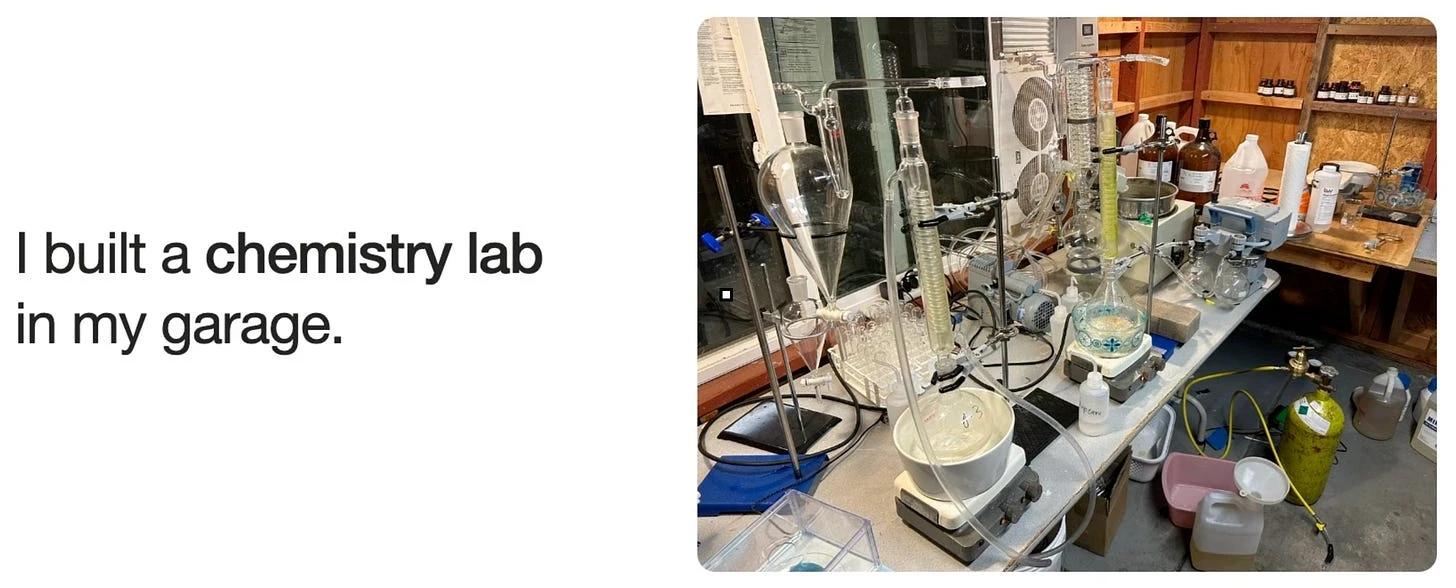
- Community take w/ Akpeli Nordor: “The technical notes seem to have no explanation of how he used OpenAI and Anthropic models to select diseases and targets, produce novel drug candidates, or do robotics. It would also be interesting to see all the biology and chemistry hypotheses he discarded. I still love the idea of being that close to inventing new drugs in a garage.”
🔬 Malva searches 74 million cells in seconds – Published in Nature by the Rajewsky Lab at MDC Berlin, Malva works like a search engine for raw genetic data: type in a DNA or RNA sequence, a mutation or a virus and it returns every matching cell from thousands of experiments, no reference genome and no downloading terabytes of files.
Image, Video & 3D
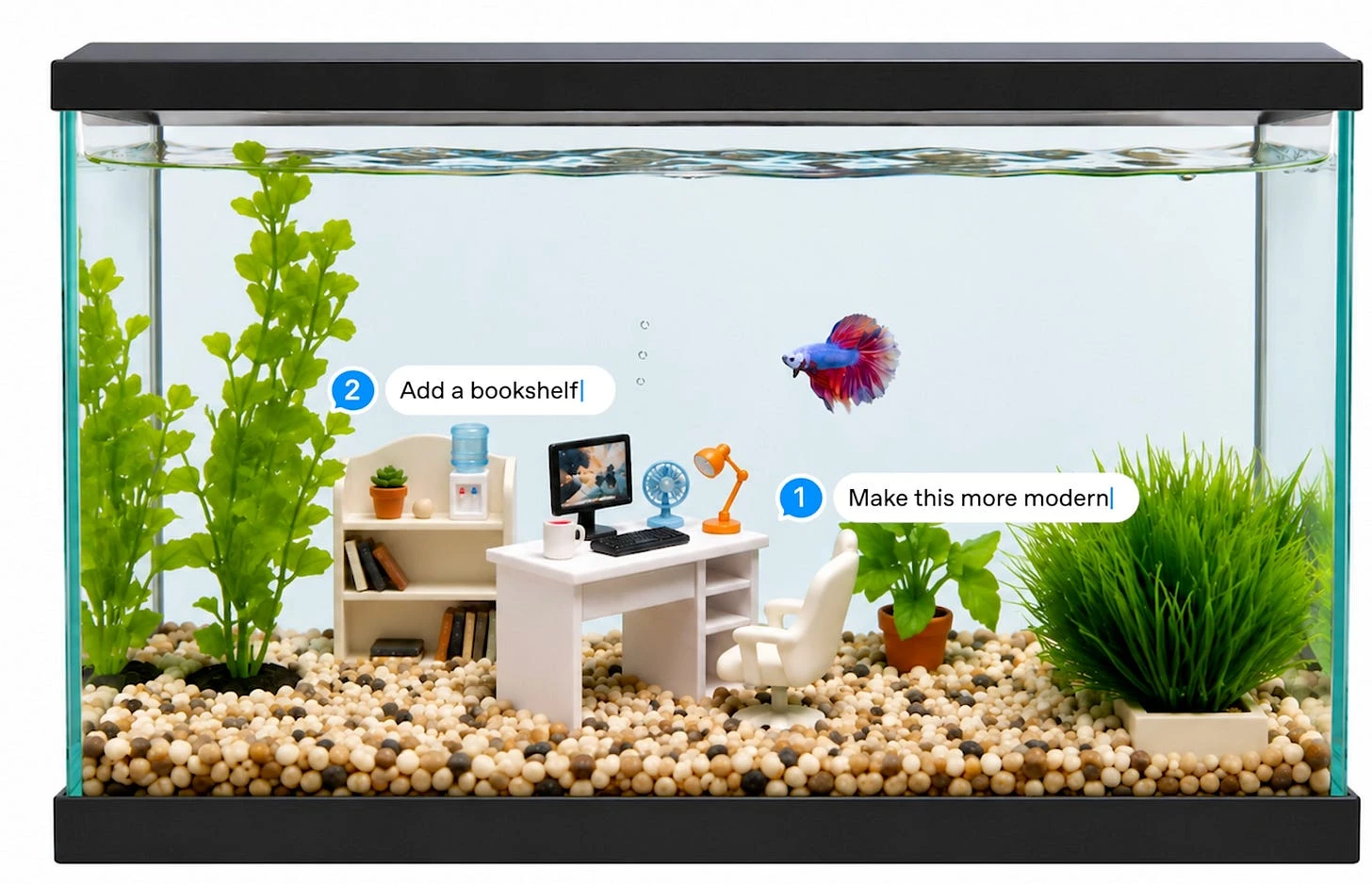
🖼️ ChatGPT Images 2.5 cuts latency in half – OpenAI’s new image model brings sharper detail, more reliable multi-turn editing and up to 50% faster generation than Images 2.0, plus Sketch, templates and on-image comments. Developers get two API variants, Flare for speed and Sunburst for precision work.
🎯 ENEAS beats SAM 3 on tracking – Speridlabs’ model takes a plain-text description and picks out the object pixel by pixel across a video, keeping track of it when it is hidden, shrinks or leaves the frame, and ignoring statues, paintings or reflections that merely look like it. It edges SAM 3 on the standard tracking benchmarks. Code on GitHub.
🕺 4DAnyone rebuilds people in 4D – This SIGGRAPH Asia 2026 framework from Ant Research takes a video of a person shot on a single phone camera and generates dozens of views from other angles, enough to rebuild them as a moving 3D model. No calibration or camera rig needed, and it runs on a consumer RTX 4090 in about 27 seconds per clip.
Cyber
🛡️ Anthropic’s September 2026 threat intelligence report – Case studies from operations disrupted between December 2025 and August 2026 across cyber, influence, surveillance, scams, bio misuse, weapons and distillation. Headline finding: AI collapsed the gap between state operations and lone operators, so sophistication no longer signals attribution.
-
Two distillation cases named Moonshot and DeepSeek serving Claude in place of their own models while collecting exchanges for training, plus a chain-of-thought distillation campaign attributed to Alibaba’s Qwen team.
-
Weapons cases included a Yemen-based cell developing guided weapons software, a Russia-based autonomous drone swarm effort and a China-based fire control specification for undersea warfare.
-
Most cyber operations let teams of agents do the scouting, break-in and data theft while humans only picked targets, and one actor set up a workflow that automatically rebuilt and redeployed its tools every time antivirus caught them.
🚪 Jacob Coxon resigns from Anthropic – The pretraining researcher, three years across OpenAI and Anthropic, said neither company is acting responsibly in the race to self-improving superintelligence and called the endgame a hubristic gamble no private company’s Slack should launch. The post drew 167 million views.
Infrastructure
🔌 AMD Instinct MI350P goes PCIe – AMD’s new accelerator ships as a standard air-cooled PCIe card with 144GB of high-bandwidth memory and up to 2300 TFLOPS at half precision, so it slots into existing servers, up to eight per box, without the liquid cooling or rack redesign its bigger data-center siblings require.
- Community take: Etienne Balit (Hypermind) noted the card is “only half of the OAM module version and requires external air cooling, but very interesting if they can price it competitively.” Clement Poiret (Rhizome Labs), who has run AMD MI GPUs, called the released ones “beasts already, the only thing lacking is the software ecosystem, but they are catching up,” and Gabriel Olympie (2501.ai) added that PyTorch and vLLM are reportedly mature on the server versions, which only ship packed by eight for half a million.
🖥️ AMD Threadripper Halo Station arrives in 2027 – AMD’s upcoming desktop workstation pairs a 96-core Threadripper PRO with its Instinct data-center accelerators for up to 2.6TB of combined memory, over three times an Nvidia DGX Station. The pitch: keep frontier-size models loaded and run hundreds of agents locally instead of paying for cloud inference.
Language Models
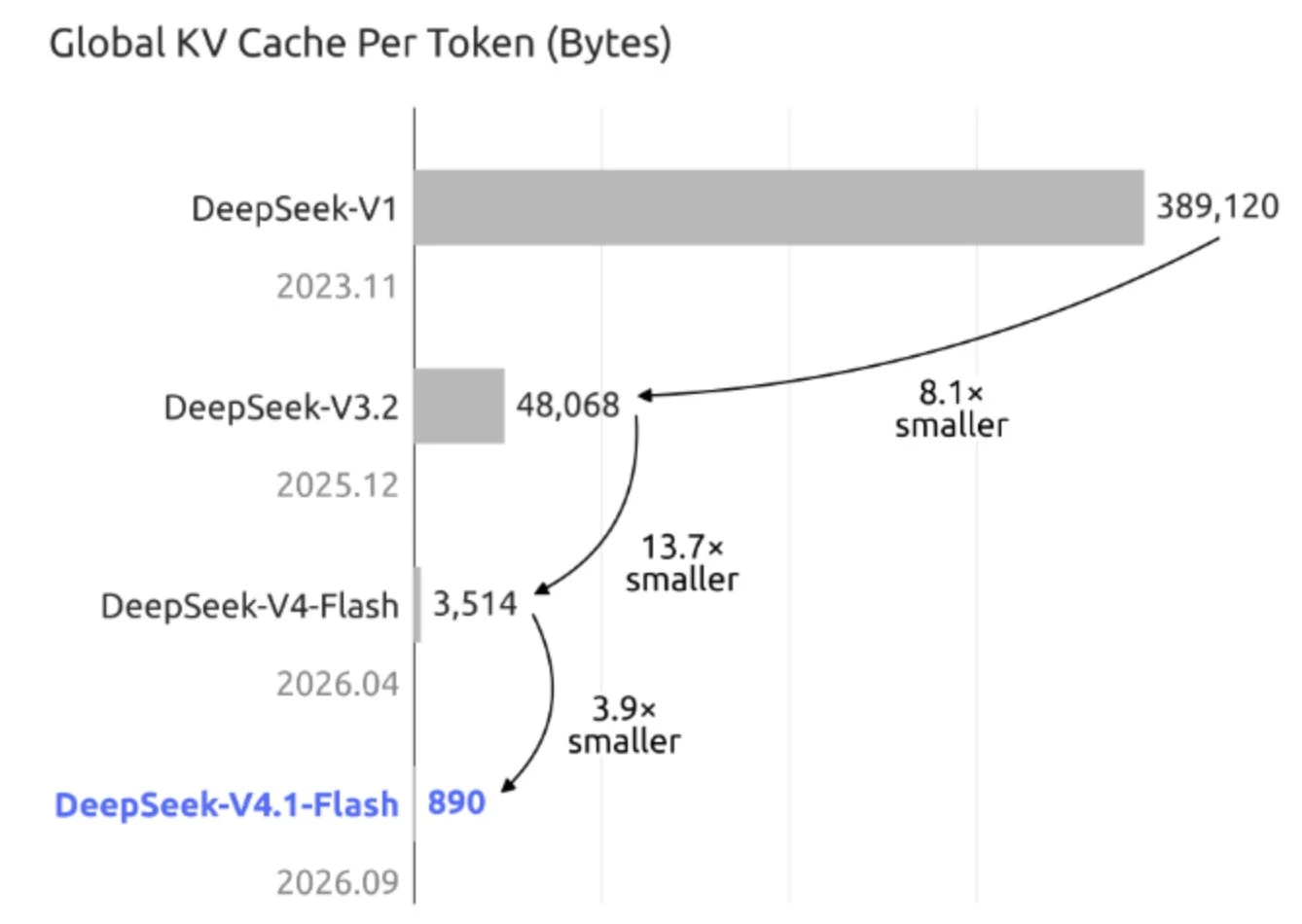
⚡ DeepSeek V4.1 Flash shrinks the KV cache – DeepSeek’s new open model reads text and images, handles a million tokens of context and, despite 552B total parameters, only switches on 8B to 16B of them per token. That makes its working memory per token roughly four times smaller than V4 Flash. It scored 90.6% on Terminal-Bench 2.1 and a 3471 Codeforces rating.
-
The trick is a split design: the first half of the network reads the input once, the second half generates from a compressed summary of it, so the model stores just 890 bytes per token of context, 437 times less than DeepSeek V1.
-
A separate 196B-parameter lookup memory stores facts outside the main network, and developers can dial reasoning effort anywhere from 1 to 100 to trade cost for accuracy.
-
Beta users get it at V4 Flash pricing by setting the model name to deepseek-v4.1-flash-expires-on-0910, capped at 20 requests at a time.
-
Community take w/ Gabriel Olympie: “DeepSeek just killed the game again. Kimi K3 level, except on very hard tasks. Most impressive feat: the 1M context KV cache fits in less than 1GB of VRAM. I think raw performance, DeepSeek is known to be pretty critical of labs who benchmax. The architecture goes back to the old encoder-decoder idea, doubling the parameter count of V4 Flash while reducing the number of parameters used per token.”
-
Community take w/ Gabriel Duciel of Arcade AI: “We’re benchmarking it right now and it doesn’t look like benchmaxxing, on some of our use cases it’s really good.”
🌊 OpenAI claims Navier-Stokes Millennium proof – Roughly 10,000 coordinated agents running an unreleased model stronger than GPT-6 Astra worked for 88 hours and 130 billion output tokens to show that a smoothly flowing fluid can develop infinite speeds in finite time, a 90-year-old open question, with the proof machine-checked in Lean. OpenAI said it will not claim the prize. Timeline.
- Community take w/ Gabriel Olympie: “It’s kind of controversial, part of the solution was about to be published before that, and OpenAI would have taken it and brute forced its way to a more complete solution. It also looks like a disproof of the current form of the equation by finding an impossible solution rather than an actual analytical solution, so impressive, but not that useful.”
🔁 GPT-6 Astra’s looped transformer internals – Sebastian Raschka explained the idea behind Astra: instead of thinking out loud in more tokens, the model reuses the same layers several times per token to think deeper inside a single pass. He also flagged its 99.9% on ARC-AGI-3 against 7.8% for GPT-5.6 Sol and its edge in 3D rendering and computer use, while independent coding indices show it ahead but not by leaps.
- Community take: Gabriel Olympie pointed to rumours that Astra “could be based on a TRM-like architecture, and could explain the jump in visual reasoning” and added “Kudos to OpenAI, first model since GPT-4 that matches the hype.” Clement Poiret of Rhizome Labs was skeptical: “After more than a year working on recursive transformers and latent reasoning, I don’t really believe in this theory. At least not a TRM or DEQ-style recursion, which are a pure nightmare for batching requests on GPUs. There are more GPU-friendly approaches like Mixture-of-Recursions, but that’s still non-trivial on standard hardware.”
🧮 Jules Pondard on mathematics after Navier-Stokes – Starting from Terence Tao’s essay “Mathematics in the age of AI”, Jules Pondard argued that once AI produces proofs in abundance, the bottleneck moves downstream. Peer review is already under strain and formal verification only checks correctness. What follows he calls absorption: simplifying, understanding and folding results into the shared knowledge that ends up in textbooks and that future research builds on. Tao’s essay.
- Community take w/ Jules Pondard: “Do we actually need humans in the loop of knowledge production? Deciding what is worth exploring is also a question of governance, especially when compute and energy remain finite and mathematics does not. And can AI reliably develop useful intermediate concepts that transfer to other contexts? Outside mathematics, this would be a little like inventing new words that are meaningful and reusable, which we don’t see AI doing.”
⚖️ Andreas Thom alleges OpenAI trained on his proof – The mathematician presented evidence that Astra may have been trained on private conversations in which he and Gábor Kun worked on Gromov’s soficity conjecture, one of the ten problems OpenAI credited to the model. The post linked it to the Alpöge and Buckmaster claims and drew 1.6 million views.
📐 Timothy Gowers asks what maths LLMs excel at – Written after OpenAI announced ten solved problems including the first non-sofic group, the Fields Medalist observed that most famous LLM results were counterexamples rather than proofs, then showed how blurry that line is via Vinogradov’s theorem and Gluskin’s Banach-Mazur result.
🔂 Mixture-of-Recursions makes looping GPU-friendly – Shared as a more GPU-friendly way to do looped reasoning, this paper reuses one block of layers and lets a small router decide how many times each token goes through it, so easy tokens exit early and hard ones think longer. At equal compute it beats standard models from 135M to 1.7B parameters. Background on the Tiny Recursive Model.
Robotic, World AI
🦆 Microduck RL environment goes PyTorch-native – A community rewrite of the training environment for the Microduck robot swaps the official Nvidia-only physics engine for a pure PyTorch one, so you can train policies on a MacBook, an AMD workstation or Nvidia GPUs without changing code, with batched and differentiable physics thrown in. Apache 2.0.
- Community take w/ Ben Sprenger: “I wanted to train new world models on Microduck, but their official RL training environment only works on CUDA and I wanted to try some runs on my Mac, so I rewrote it from scratch with PyTorch-native physics. Anyone who has messed around with the Microduck, I’m looking for ideas on what to train it to do with world models.”
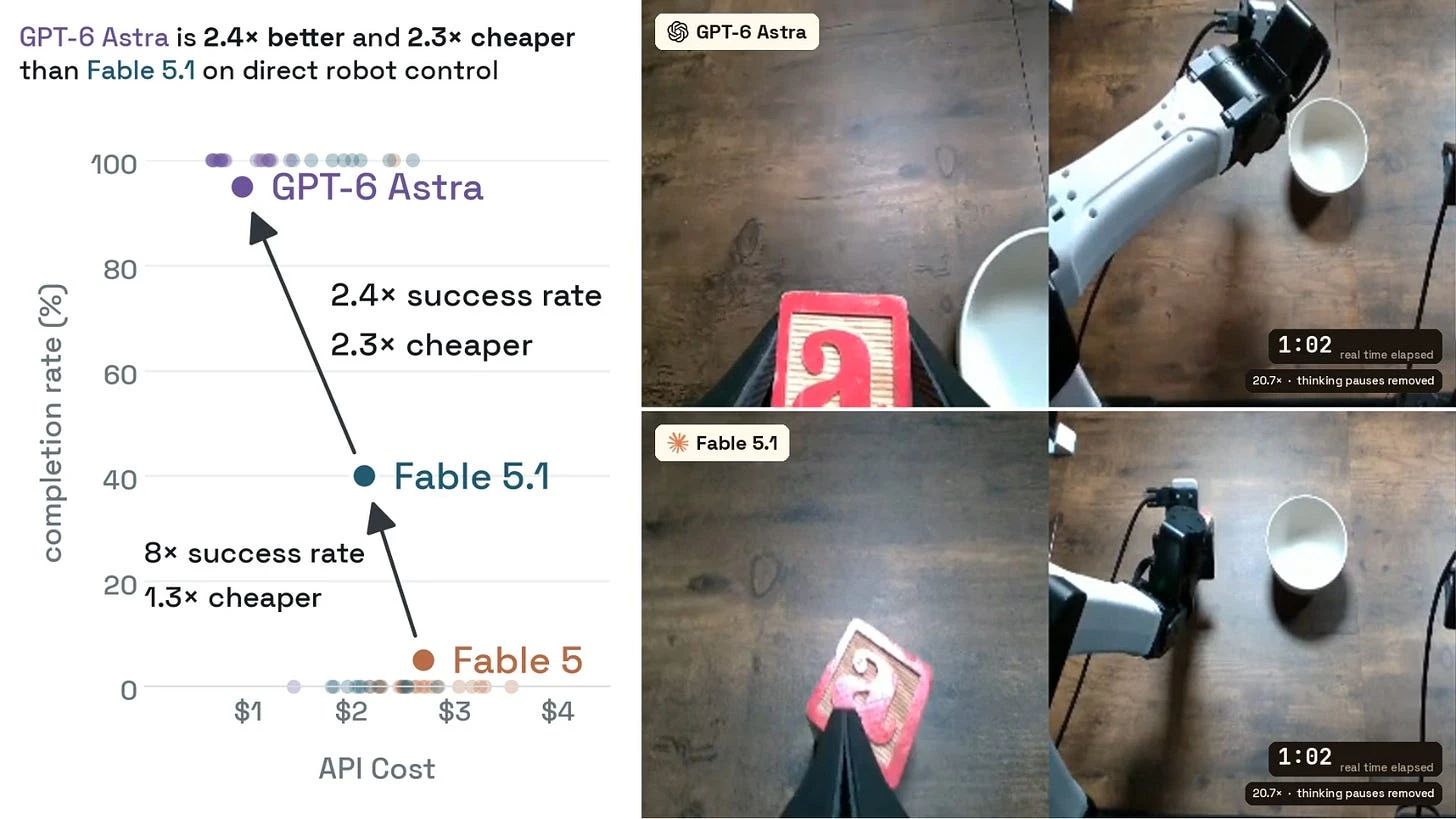
🦾 GPT-6 Astra drives YAM robot arms – Robocurve had Astra control the same two robot arms with the same setup used for Claude Fable 5.1: it put a block into a bowl in 19 of 20 tries at $0.94 a run versus Fable’s 8 of 20 at $2.12, but both models failed a puzzle-piece insertion task at the same final step, 2 of 20 each. Grading was not blinded.
Other topics
🧹 unslop.news strips AI from Hacker News – A filtered mirror of Hacker News that removes AI-related submissions, showing 85 of 180 stories at the time of sharing, topped by Shopify acquiring Tailwind and Rust becoming a tier-1 language at Microsoft.
Community Updates
🎓 FluenTea lands first paid university partner – Nancy Wang’s video conferencing plus AI language learning platform received its first payment from a university partner: around 500 students at TESI in Mexico are following Beginner English this semester!
Contributors This Week
Gabriel Olympie, Leonard Strouk, Félix Raimundo, Quentin Dubois, Akpeli Nordor, Clement Poiret, Amine Saboni, Ashley van Heteren, Khalil Ouardini, Ben Sprenger, Constant Razel, Etienne Balit, Gabriel Duciel, Georges Gomes, Glenn Sonna, Ihab Bendidi, Jean du Terrail, Julien Millet, Khaled Maâmra, Louis Abraham, Louis Choquel, Nancy Wang, Thierry Abalea, Maximilian Rowoldt